


Mike Allen wrote a great piece this week about a shift we’ve been thinking about since we started Ombox: In the era of intelligence the system of record might survive, while the work moves somewhere else.
His framing is that automotive software has historically won by owning the record. The DMS held the vehicle and transaction data. The CRM held the customer. Other systems accumulated around them. But people are becoming the ‘integration layer’ or as I like to frame it
People have become middleware
A salesperson checks the CRM, opens the DMS, looks at stock, checks another system, copies some information across, sends a message, sets a reminder and hopefully remembers to follow up. The individual systems might technically be integrated. But the actual operating system holding everything together is often a person. That’s the problem we’re building Ombox to solve.
The dealership became a human operating system
We’ve spent decades digitising dealerships by adding software. Every new problem created another product. CRM. DMS. Finance. Stock. Marketing. Telephony. Manufacturer systems. Spreadsheets. Portals. Each may be perfectly good at its individual job. But somebody still needs to decide what needs doing, gather the context from different places, move information between them and make the next thing happen. That’s not really automation. It’s a human operating system sitting on top of a fragmented technology stack. And adding another dashboard isn’t going to fix it.
We’re building the operating layer
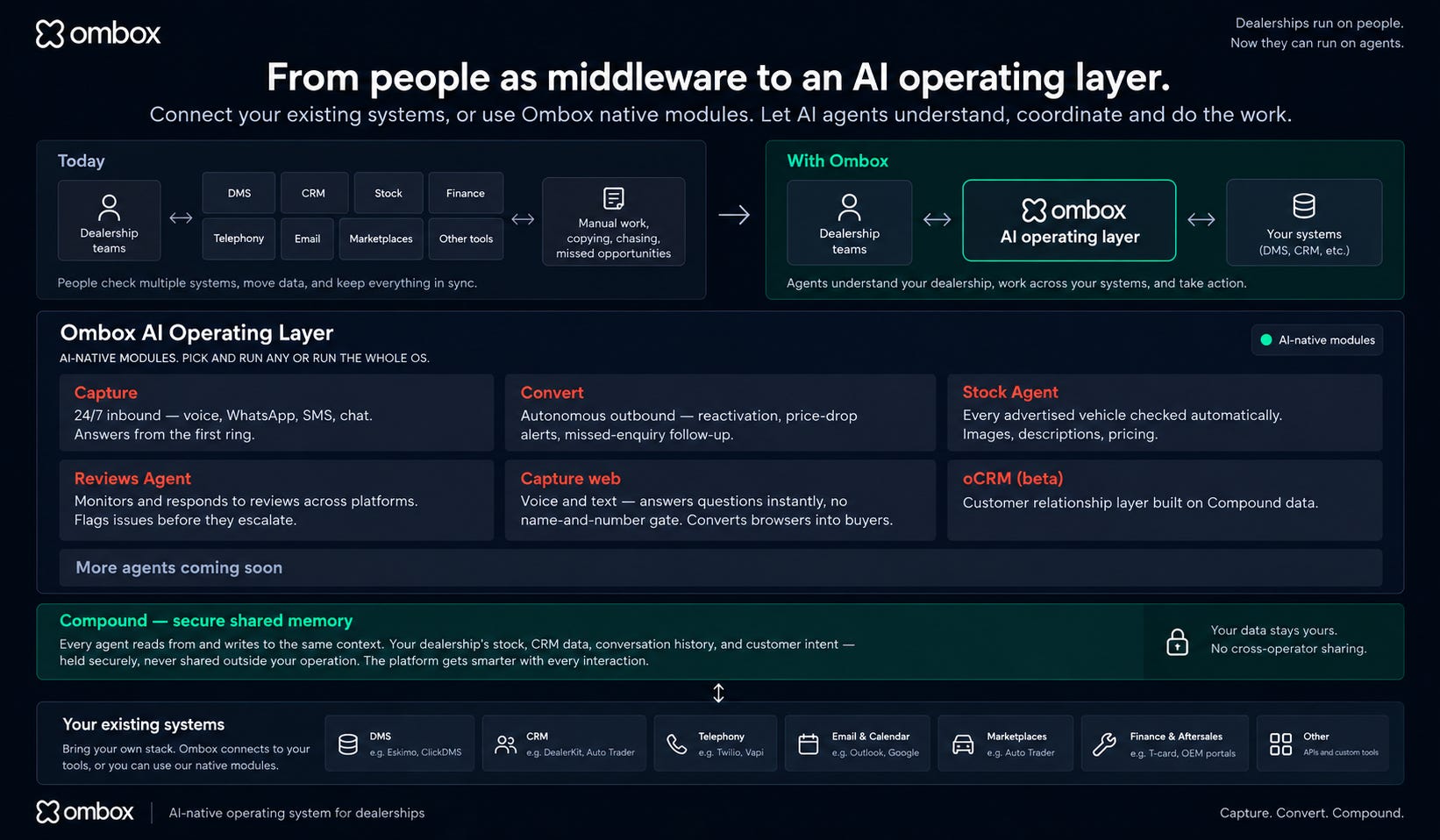
This is the core thesis behind Ombox.
Dealerships don’t need to rip out every system they already use. The DMS can remain the system of record. The CRM can remain the system of record. Stock systems, finance platforms, telephony, marketplaces, email and calendars can all continue doing what they’re good at.
What needs to change is the layer above them.
Today, that layer is mostly people. People check one system, move information to another, remember what needs to happen next, chase the customer, update the record and keep the whole thing moving. People have become the middleware, and eventually the operating system itself.
We’re building Ombox to replace that operating layer with software. The important thing about this architecture is that Ombox doesn’t require a dealership to choose between its existing technology and an AI-native future.
Bring your DMS. Bring your CRM. Bring your stock feeds, telephony, email, calendars, finance systems and other tools. Ombox connects across them and gives agents the context they need to act. Where it makes sense, dealerships can also use our AI-native modules instead.
The systems underneath can remain systems of record. Ombox becomes the layer that understands what’s happening across them and gets the work done.
That distinction is important. A chatbot added to a CRM still leaves a person operating the CRM. A copilot that produces a summary still leaves a person deciding what to do with it. Even an isolated AI agent can simply become another tool somebody has to manage.
The operating layer is different. It coordinates the work. A customer calls. Capture understands why. A conversation creates intent. That context is available to Convert. Stock information can inform what happens next. The CRM record can be read or updated. An appointment can be made. The outcome becomes part of the same shared context. The person doesn’t need to carry information between each step.
AI-native modules, not another collection of point solutions
This is why we’re building Ombox as a set of AI-native modules running on one operating layer.
Capture handles inbound conversations across voice, WhatsApp, SMS and chat. Convert works autonomously across outbound opportunities such as CRM reactivation, missed enquiries and price-drop campaigns. Stock Agent continuously checks vehicle merchandising. Reviews Agent monitors and responds across review platforms. Capture web turns dealership websites from forms into conversations. oCRM is our AI-native customer relationship layer.
A dealership doesn’t have to adopt all of them. If you love your existing CRM, keep it. If your DMS works, keep it. If you already have a system that does a particular job well, Ombox should work with it rather than force you to replace it.
You can start with one agent solving one problem. But every Ombox agent is designed around the same architecture, so as more of the operating layer is adopted, the dealership doesn’t end up with another collection of disconnected tools.
That’s the difference between building agents and building an operating system.
Compound is what holds it together
Underneath those agents sits Compound, our secure shared context layer. Every agent can read from and write to the same dealership context: stock, CRM data, conversation history, customer intent and the outcomes of previous interactions. That means an inbound phone conversation isn’t trapped inside a voice product. An SMS response isn’t trapped inside an outbound tool. A stock signal doesn’t exist independently from what we know about a customer.
The dealership starts developing an operational memory.
And that memory compounds.
Which customers respond? Which conversations turn into appointments? Which signals indicate genuine buying intent? When should someone be contacted? What happened after the agent handed a customer to the dealership? Did they ultimately buy? The more work the operating layer performs, the more context it develops about how that particular dealership works. That feedback loop is much more interesting to us than simply putting an LLM on top of a database.
This is also why we built Ombox Labs
There is another problem with building an operating system: you can’t discover the entire operating model of a dealership from behind a desk. Some of the most valuable workflows don’t fit neatly into existing software categories.
Someone checks something every morning. Someone downloads a report and compares it against another system. Someone knows which customers need chasing because they’ve learned to recognise a particular pattern. Someone notices a problem and messages three other people to get it resolved.
Often, nobody thinks of these things as software problems. They’re just “how we do things.”
Ombox Labs exists to find them.
We work directly with dealerships to identify places where people are still acting as middleware, build agents around those workflows and test them in the real world. Some will remain specific to an individual dealer. Others will become agents, capabilities or shared primitives inside the Ombox operating layer. Labs is how the OS keeps expanding into the work.
We can’t replace SaaS sprawl with agent sprawl
This is the trap the industry needs to avoid. Dealerships spent the last decade accumulating point solutions. Now AI makes it incredibly easy to accumulate point agents.
An AI receptionist. An AI lead responder. An AI email tool. An AI stock tool. An AI service agent. An AI assistant inside the CRM. Individually, each might be useful. Collectively, we risk recreating exactly the architecture we’re trying to escape.Because if somebody has to move context between all those agents, decide which one should act and keep their outputs synchronised, the person is still the operating system. We’ve just given them more software to operate. The opportunity with AI is much bigger than that.
The goal is for software to disappear
The best version of this future is probably surprisingly boring. The systems you know still exist. But dealership employees spend dramatically less time moving between them.
Ombox Agents handle the coordination, communication and repetitive execution happening across those systems. People spend more time on the things where people actually add value: judgement, relationships, negotiation, exceptions and great customer experiences.
The measure of successful AI adoption shouldn’t be how many AI products a dealership has bought.
It should be how much work has disappeared.
That’s what we’re building Ombox around. Not another system for dealerships to operate. The operating layer that means people don’t have to be the operating system.
We can help. Talk to us!