


Every December, investors predict where the world of tech is heading into the following year. But 2026 predictions all converge on a single theme: AI is no longer about answering questions. It is about coordinating real work, across messy data, physical processes, and multi-party workflows.
For dealerships, this shift is seismic.
For Ombox, it is the world we are building for.
Here are the four ideas from the 2026 Big Ideas reports by a16z that matter most for automotive retail.
1. The world is drowning in unstructured, multimodal data
(Part 1: Jennifer Li , “taming multimodal data”)
Dealerships run on:
• calls
• voicemails
• videos
• WhatsApp threads
• service emails
• invoices and PDFs
• hand-written notes
• CRM records that are outdated within minutes
This is multimodal entropy.
Models hallucinate when the data underneath is chaotic. Software breaks when context is inconsistent.
Investors say the next wave of AI winners will be the ones who can turn this chaos into structured, retrievable, trusted knowledge.
This is exactly what Ombox is designed for.
Our AI listens, transcribes, interprets, and structures every customer touchpoint in real time.
The more chaotic the dealership world gets, the more valuable a context-cleaning layer becomes.
2. AI workflows will be agent-native
(Part 1: Malika, “agent-native infrastructure”)
Agents do not work like people.
A single request from a service advisor might trigger:
• 30 database lookups
• 10 reasoning passes
• 50 small tool calls
• multi-step workflows that update multiple systems
Legacy CRMs and phone software were never built for this.
Dealerships run into this already when they ask simple things like:
“Find all customers who missed their MOT reminder, check the call logs, and draft personalised follow-up messages.”
Humans do this with judgment and context, which will continue to be an important layer
AI can only do this if the infrastructure underneath supports recursive, bursty reasoning.
Ombox is being built as an agent-native dealership brain, not a chatbot.
This distinction will define the winners in this space.
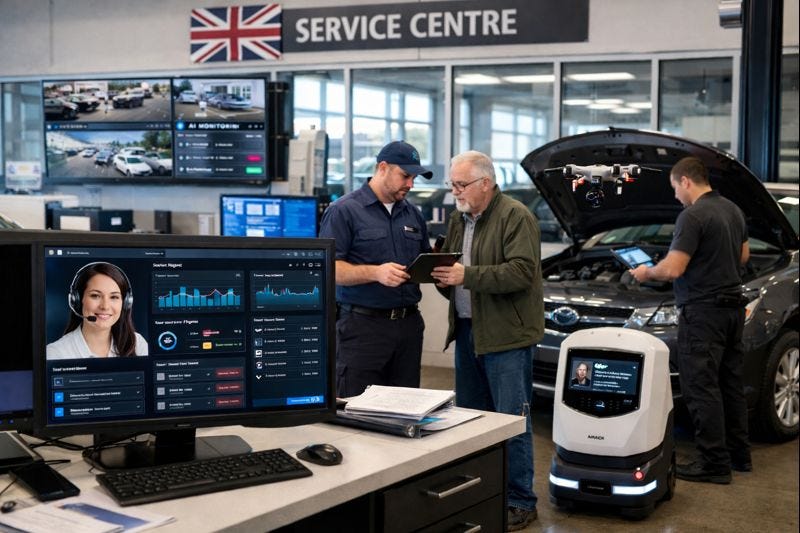
3. Systems of record become passive. The AI layer becomes the interface.
(Part 1: Sarah Wang , “systems of record lose primacy”)
This is the biggest shift for dealerships.
Today:
• Systems of Record
• Excel
• Shared inboxes
• WhatsApp
• Calendar systems
• Voice recordings
All act as separate systems of record. Staff jump between them constantly.
The prediction:
In 2026, the system of record stops being the place where work happens.
The AI layer becomes the surface where work is actually done.
The CRM becomes a database.
The AI becomes the workflow.
We’re working on Ombox to become the system of context
“Find every customer from yesterday’s calls who asked for a valuation. What happened, what’s the next action, and draft the follow up.”
This is not querying a CRM.
It is orchestrating work.
This is where the industry is going.
4. Voice agents expand from a wedge to full customer cycle management
(Part 2: Olivia Moore, “voice agents take up space”)
Voice went from novelty to mission-critical in 18 months.
The next wave is not:
• “AI that handles a few call types”
The next wave is:
• AI that manages an entire customer relationship cycle
• voice, WhatsApp, email, SMS, all coordinated
• tool-calling
• context maintenance
• booking tasks
• updating systems
• proactive outreach
• full customer loop closure
This is the direction Ombox is already operating in:
• inbound
• missed call recovery
• outbound campaigns
• WhatsApp intelligence
• structured follow ups
• customer history retrieval
• proactive prompts powered by OmboxGPT
We are not a voice agent.
We are an AI customer operations engine.
Voice is the entry point, not the destination.
5. The future is multi-agent coordination, not single-agent answers
(Part 2: Seema Amble , “the orchestration layer arrives”)
The Fortune 500 will shift from “AI tools” to “AI teams.”
Dealerships will follow the same path, because they are fundamentally multi-party operations:
• sales
• service
• parts
• marketing
• finance
• aftersales
• BDC
Ombox is being built as a multi-agent system, not a monolithic assistant.
Agents that:
• specialise
• hand off
• escalate
• maintain context
• read from systems
• write into systems
• collaborate with staff
• surface the edge cases for humans
Dealership AI will not be a single assistant.
It will be a coordinated digital team.
This aligns exactly with the 2026 prediction.
6. Proactive, prompt-free software becomes the new normal
(Part 2: Marc Andrusko , “prompt-free and proactive applications”)
Customers will not ask AI what to do.
AI will tell them.
Imagine Ombox saying:
“Three service customers from yesterday need follow ups. The WhatsApp drafts are ready.”
Or:
“You have a spike in missed calls today. I’ve triaged them and queued recommended actions.”
Or:
“Here are five customers whose MOT is due in 30 days. Shall I reach out?”
This is where your product is naturally heading, and the ecosystem agrees.
Why this matters for dealerships
Dealerships are not competing on software features any more.
They are competing on:
• speed
• coordination
• responsiveness
• retention
• friction reduction
The industry shift investors are predicting is the same shift Ombox is built around.
This is a rare moment where the macro trend and the product vision match perfectly.
Investor outreach: investor@ombox.ai