


There is no shortage of big claims in software.
Everyone wants to be the platform. The operating system. The unified layer. The AI-native stack.
I understand why. Those narratives are ambitious, expansive, and investor-friendly. But they can also blur the truth of what a product actually does and where it actually delivers value.
At Ombox, we have been thinking a lot about how to describe what we are building for dealerships.
And the more we looked at it, the clearer it became:
We are not building a dealership OS.
We are building the DemandOps layer for dealerships.
That distinction matters.
The problem is not that dealerships lack systems
Most dealerships already have systems.
They have DMS platforms, websites, lead sources, calendars, inboxes, telephony setups, WhatsApp threads, spreadsheets, group chats, and all sorts of operational workarounds stitched together over time.
The issue is not the absence of software.
The issue is what happens between customer intent and dealership action.
A missed call.
A service enquiry that gets buried.
A sales lead that waits too long for a response.
A customer who wants to book work but cannot get through.
A conversation that starts in one channel and disappears in another.
A team that is busy, under pressure, and constantly context-switching.
That is where revenue gets lost.
Not because the dealer lacks a database.
Because demand is not being operationalised well enough.
Why “dealership OS” isn’t the right framing from our perspective
When people say “dealership OS,” they are usually describing something much broader and heavier.
That implies the full system of record.
The core operational backbone.
The place where the dealership runs everything.
In practice, that starts to sound much closer to a DMS replacement or a fully integrated retail platform.
That is not our lane today.
We are not trying to rip out the dealership stack and ask operators to rebuild their business around us.
We are trying to solve a much more immediate and painful problem:
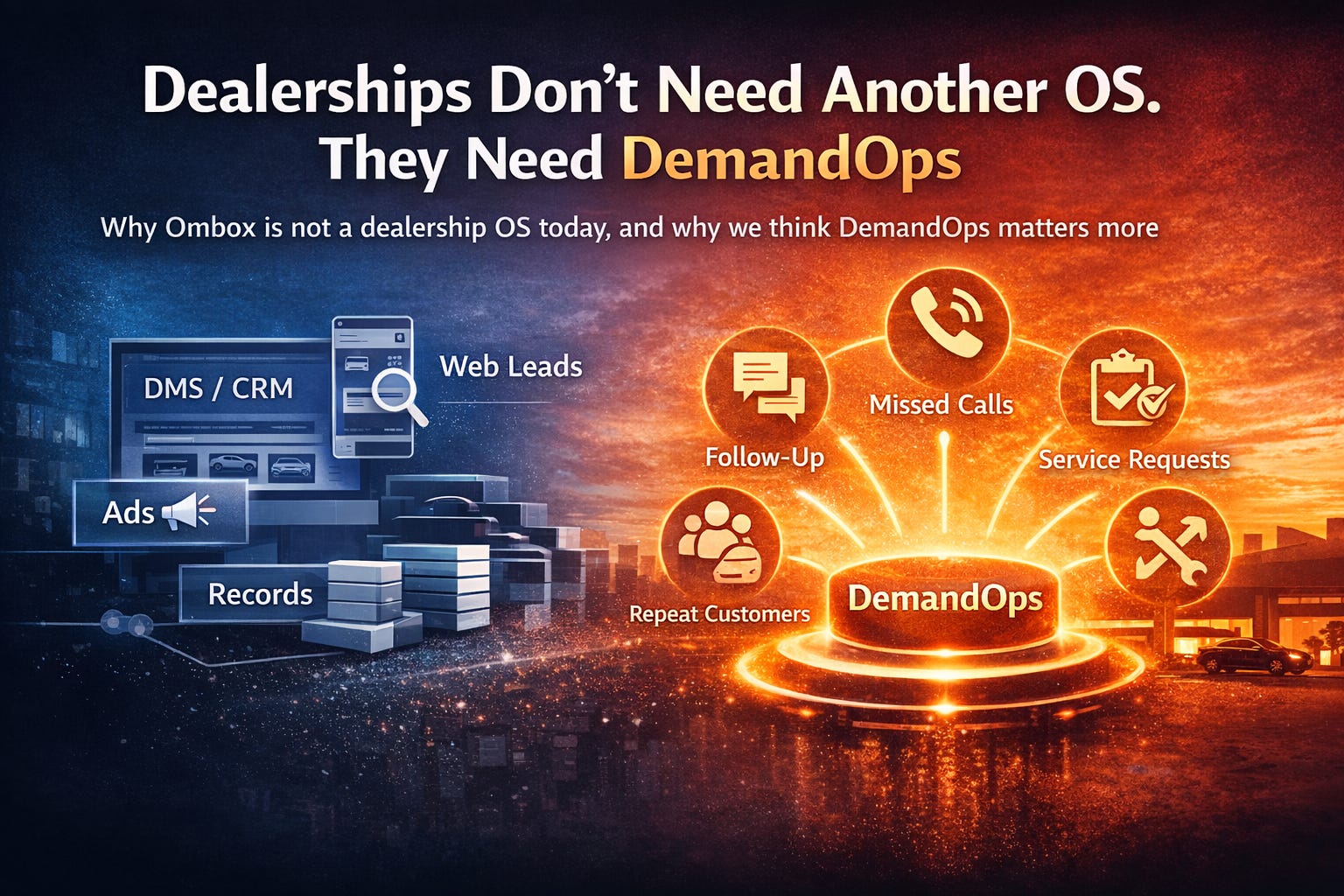
How do dealerships capture, respond to, route, and follow up on every revenue opportunity across sales and aftersales?
That is a different job.
And in our view, it is one of the most underbuilt parts of the stack.
Demand exists across the whole customer journey
One of the reasons we like the term DemandOps is that it is broader than sales, but still grounded.
It covers front-end demand such as:
inbound calls
sales enquiries
test drive requests
finance questions
valuation requests
But it also covers aftersales demand such as:
service bookings
MOT reminders
workshop enquiries
parts questions
missed-call recovery
reactivation of existing customers
Aftersales is still demand.
It is just demand from an existing customer base rather than a net-new buyer.
In some ways, aftersales may be the clearer expression of the category.
The workflows are more repeatable.
The commercial value is easier to trace.
The cost of poor responsiveness is very real.
And the compounding effect is powerful.
A missed service booking is not just a missed call.
It is lost workshop revenue, lost retention, and often a lost future customer relationship.
The role Ombox plays
We think of the dealership stack like this:
systems of record hold the data
demand sources generate customer leads
Ombox sits in the middle as the layer that captures, routes, follows up on, and compounds that demand
We are the layer that helps dealerships make more money from the opportunities they already have.
That includes:
answering and triaging inbound conversations
handling out-of-hours and overflow demand
keeping context across channels
making sure enquiries do not disappear
helping teams follow up faster and more consistently
creating a cleaner path from conversation to booking, appointment, or sale
Why this framing matters
Categories shape product strategy.
If we tell ourselves we are building a dealership OS, we drift toward system replacement, broad abstractions, and a much bigger promise than the product needs to make right now.
If we tell ourselves we are building DemandOps for dealerships, the focus becomes sharper.
We care about:
speed to response
continuity of context
recovery of missed demand
conversion across channels
compounding revenue over time
That is a clearer wedge.
It is also a more honest one.
And in a market full of tools that either generate demand or store records, there is real room for a layer that actually operationalises customer demand properly.
Our belief
Dealerships do not need another broad operating system, atleast not today.
They need a better way to capture, respond to, and convert demand across sales and aftersales.
That is why we are building the DemandOps layer for dealerships.
Interested?
If you are thinking about how your dealership handles inbound demand across sales and aftersales, we’d love to talk.